Sustainability
Corporate Governance
Basic Approach to Corporate Governance
We believe that improving profitability and capital efficiency, with the aim of enhancing long-term corporate value, is the top priority for all stakeholders, including our shareholders. Therefore, in addition to establishing an internal control system, we will strive to ensure the transparency and soundness of management and continuously strengthen our corporate governance.
Corporate Governance Structure
As a company with an Audit & Supervisory Board, we have adopted a structure that incorporates the functions of a company with a Nomination Committee and Remuneration Committee into our basic organizational design. This enhances the objectivity and transparency of management, including the appointment of directors and the determination of remuneration. Furthermore, by introducing the Executive Officer system, we have clearly separated supervision from execution, establishing a structure capable of responding swiftly to changes in the external environment. Furthermore, starting in June 2024, we introduced a Corporate Officer system and appointed a CEO (Chief Executive Officer) to clarify the highest-level executive responsibility for group management. The Corporate Officer, as the highest-ranking executive position within our group with a company-wide perspective, bears responsibility for the Company's management execution. By attending Board of Directors meetings to explain proposals and respond to questions, the Corporate Officer further strengthens the supervisory function of the Board of Directors.
| Overview of the Corporate Governance Structure | |
|---|---|
| Board of Directors | The Board of Directors shall, bearing in mind its fiduciary responsibility to shareholders, fulfill its role and responsibilities to promote the company's sustainable growth and enhance its medium- to long-term corporate value, thereby improving profitability and capital efficiency. This includes setting the broad strategic direction for the company, exercising effective oversight of directors and executive officers from an objective standpoint, and establishing an environment that supports appropriate risk-taking by senior management. |
| Board of Auditors | Based on the audit plan determined by the Board of Auditors, the Board of Auditors shall conduct operational and accounting audits by attending important meetings and reviewing important documents related to business execution and shall audit the execution of duties by directors. |
| Nominating Committee | Established as an internal committee of the Board of Directors, it proposes candidates for Chief Executive Officer (CEO), directors, and independent directors to the Board of Directors. |
| Remuneration Committee | Established as an internal committee of the Board of Directors, it proposes Remuneration systems for directors, corporate officers, and executive officers, as well as the Remuneration details for the CEO (Chief Executive Officer), to the Board of Directors. |
| Corporate Officers Meeting | To deliberate and resolve on important management matters, including those delegated by the Board of Directors. |
| Executive Officers Meeting | Based on the fundamental policies determined by the Board of Directors, formulate, decide, and execute the overall daily operational policies and plans. |
| Compliance Committee | Established as an organization directly under the CEO, it monitors and verifies the compliance framework and information security framework, makes recommendations to the CEO as necessary, and reports to the Board of Directors. |
| Risk Management Committee | Established as an organization directly under the CEO, it identifies high-priority issues, monitors the status of responses to company-wide or long-term risks, conducts multifaceted and objective verification, makes recommendations to the CEO as necessary, and reports to the Board of Directors. |
| Sustainability Committee | As an organization directly under the CEO, it collects information related to sustainability, including climate change risk response, incorporates it into business strategy, and promotes related activities. It makes recommendations to the CEO as necessary and reports to the Board of Directors. |
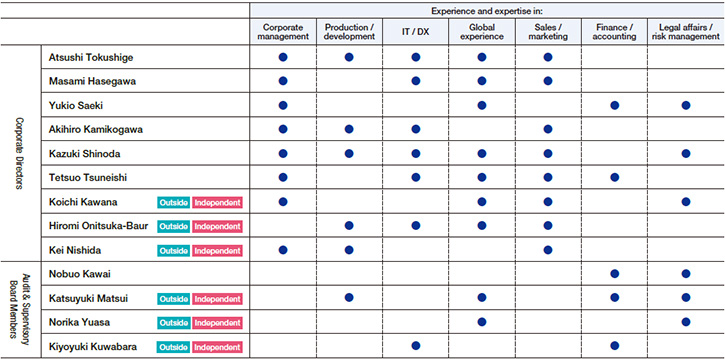
Skill Matrix for Directors and Auditors
Under the mid-term management plan VISION2030, we will pursue sustainable growth and enhance corporate value over the medium to long term, while also focusing on management that prioritizes strengthening our governance framework. In executing VISION2030, considering our current circumstances and the challenges we must address, the Board of Directors has determined the following areas of experience and expertise to be important at this time. Based on this, we have established a well-balanced composition of directors and auditors.
Board Attendance by Directors
| Position as of Mar 31, 2026 | Name | Attendance at Board of Directors Meetings in FY2025 |
|---|---|---|
| President & Representative Director, CEO | Atsushi Tokushige | 100% (13/13) |
| Representative Director | Masami Hasegawa | 100% (13/13) |
| Corporate Director | Takayoshi Miyamoto | - Assumed the role in Jun 2025 |
| Corporate Director | Tetsuo Tsuneishi | 100% (13/13) |
| Corporate Director (Outside Director, Independent Director) |
Hiromi Onitsuka-Baur | 100% (13/13) |
| Corporate Director (Outside Director, Independent Director) |
Kei Nishida | 100% (13/13) |
| Corporate Director (Outside Director, Independent Director) |
Seiji Osaka | 100% (10/10) Assumed the role in Jun 2024 |
Board and Board of Auditors Attendance by Auditors
| Name | Attendance at Board of Directors Meetings in FY2025 | Attendance at Board of Auditors in FY2025 | |
|---|---|---|---|
| Audit & Supervisory Board Member (full-time) | Nobuo Kawai | 100% (13/13) | 100% (8/8) |
| Outside Audit & Supervisory Board Member (full-time) | Kazuya Ishiguro | - Assumed the role in Jun 2025 | - Assumed the role in Jun 2025 |
| Outside Audit & Supervisory Board Member | Norika Yuasa | 100% (13/13) | 100% (8/8) |
| Outside Audit & Supervisory Board Member | Kiyoyuki Kuwabara | 100% (13/13) | 100% (8/8) |
Reasons for Appointing Outside Directors (Independent Officers)
| Name | Reasons for Appointment |
|---|---|
| Hiromi Onitsuka | Leveraging her expertise in the electrical machinery and IT industries, along with her experience as an auditor and outside director (audit committee member) at listed companies, she has served as an outside director of our company. Beyond participating in the Board of Directors and the Nomination Committee, she has led the operations of the Remuneration Committee as its Chairperson since June 2022, ensuring effective oversight of management. We expect that her opinions and observations, informed by a shareholder perspective, will continue to ensure objective oversight that protects minority shareholder interests and promotes diversity. Therefore, we have invited her to serve as an outside director. There are no special relationships between her and the Company, such as capital or personnel ties. Furthermore, as she meets the Company's “Criteria for Appointing Independent Directors,” we have determined that there is no risk of a conflict of interest with general shareholders and designate her as an independent director. |
| Kei Nishida | Leveraging his management experience at listed companies and expertise in the electronics industry, he has served as an outside director of our company, participating in the Board of Directors and the Remuneration Committee. Since June 2023, he has also led the Nomination Committee as its Chairperson, driving the committee's operations and ensuring effective oversight of management. We expect that his opinions and observations, informed by a shareholder perspective, will continue to ensure objective oversight that protects minority shareholder interests and promotes diversity. Therefore, we have invited him to serve as an outside director. There are no special relationships between him and the Company, such as capital or personnel ties. Furthermore, as he meets the Company's “Criteria for Appointing Independent Directors,” we have determined that there is no risk of a conflict of interest with general shareholders and designate him as an independent director. |
| Seiji Osaka | Leveraging his expertise in the electronics industry, management experience at listed companies, and extensive overseas assignment experience, he has effectively supervised management as an outside director of our company through participation in the Board of Directors, Nomination Committee, and Remuneration Committee. We expect him to continue providing objective oversight that protects minority shareholder interests and promotes diversity, based on perspectives and insights aligned with shareholder interests. Therefore, we have invited him to serve as an outside director. There are no special interests between him and the Company, such as capital or personnel relationships. Furthermore, as he meets the Company's “Criteria for Appointing Independent Directors,” we have determined that there is no risk of a conflict of interest with general shareholders and are designating him as an Independent Director. |
Reasons for Appointing Outside Auditors (Independent Officers)
| Name | Reasons for Appointment |
|---|---|
| Kazuya Ishiguro | With extensive experience spanning financial and accounting departments as well as overall business management at listed companies and their group companies, he possesses expertise in finance and accounting. He also brings practical experience gained over many years as an auditor and as a director serving on audit committees. With a view to further strengthening our manufacturing capabilities, we expect him to enhance and reinforce our audit functions and have therefore invited him to serve as an Outside Auditor. There are no special interests between him and the Company, such as capital or personnel relationships. Furthermore, as he meets the Company's “Criteria for Appointing Independent Directors,” we have determined that there is no risk of a conflict of interest with general shareholders and are designating him as an Independent Director. |
| Norika Yuasa | After practicing law in China and other countries, she currently serves as a partner at Miura Law Office, possessing extensive experience and specialized knowledge. We expect her to leverage this experience and expertise to objectively ensure the appropriateness of audits and have therefore invited her to serve as an outside auditor. There are no special interests between her and the Company, such as capital or personnel relationships. Furthermore, as she meets the Company's “Criteria for Appointing Independent Directors,” we have determined there is no risk of a conflict of interest arising with general shareholders and are designating her as an independent director. |
| Kiyoyuki Kuwabara | With extensive expertise in finance and accounting gained through years of experience as a certified public accountant at an audit firm, and practical experience as a full-time auditor (outside auditor) at a listed company, we expect this individual to strengthen our audit function through an objective perspective leveraging this experience and expertise. We have therefore invited him to serve as an outside auditor. There are no special interests between him and the Company, such as capital or personnel relationships. Furthermore, as he meets the Company's “Criteria for Appointing Independent Directors,” we have determined that there is no risk of a conflict of interest arising with general shareholders and have designated him as an independent director. |
Policy for Determining Director Remuneration Calculation Methods
(Basic Policy on Director Remuneration)
The key points emphasized in the basic policy on director remuneration for our Group are as follows:
- A competitive level and system to secure outstanding management talent within Japan
- Strong linkage between short-term performance and medium-to-long-term corporate value enhancement for sustainable growth
- Ensuring transparency and fairness in the remuneration determination process, and the appropriateness of remuneration
(Approach to Director Remuneration Levels)
- As remuneration for directors of a company whose mission is to address social issues through leading-edge technology, primarily semiconductors and IT, and to contribute to the sustainable development of society by offering solutions to those issues that have value beyond expectations, we aim for a competitive level among Japanese companies operating in this field.
- Fixed director remuneration is benchmarked based on external survey data, reflecting each director's functions and responsibilities.
- Variable remuneration for directors must incorporate elements linked to the Company's performance level. Therefore, we set annual performance-based remuneration within 5% of “Net Income Attributable to Owners of the Parent Company.”
- Medium-to-long-term incentive remuneration is set based on the target financial model, period, and other factors.
(Remuneration Structure)
- Directors with Business execution
Composed of a fixed monthly salary, annual performance-based remuneration, and mid-to-long-term incentive remuneration. A portion of the annual performance-based remuneration and the mid-to-long-term incentive remuneration are provided as stock-based remuneration. - Directors with Non-business execution
Composed of a fixed monthly remuneration and non-performance-linked equity remuneration. Note: The retirement benefit system for directors of the Company has been abolished for periods starting from the fiscal year ending March 2015.
(Fixed Remuneration)
- Directors with Business execution
Utilizing data from external research institutions, remuneration levels for each position at companies with similar market capitalization and scale are used as benchmarks. Based on these benchmarks, a fixed remuneration table has been established. This table sets the remuneration level range for each position at the Company relative to the President and Representative Director, whose remuneration is set as 100. Furthermore, based on data from external research institutions, the Remuneration Committee formulates a fixed remuneration proposal for the President and Representative Director, which is then decided by the Board of Directors. Applying the determined fixed remuneration amount for the President and Representative Director to the fixed remuneration table calculates the fixed remuneration ranges for directors in other positions. Within these ranges, the President and Representative Director determines the fixed remuneration amounts for other directors. - Directors with Non-business execution
Fixed remuneration ranges are established based on data from external research organizations. Allowances are paid for membership on the Nomination and Remuneration Committees. For committee chairs, a separate chairperson allowance is paid in addition to the committee member allowance.
(Annual Performance-Based Remuneration)
- Annual performance-based remuneration is established as a remuneration system that clearly links the remuneration of executive directors to the Company's performance and shareholder value. Its purpose is to enhance motivation for achieving performance improvements and awareness of contributing to increasing shareholder value.
- Annual performance-based remuneration is calculated based on an annual performance-based remuneration table using the following metrics: the amount of “Net Income Attributable to Owners of the Parent” for the fiscal year (hereinafter referred to as “Net Income Amount”) and the ratio of Net Income Amount to net sales (hereinafter referred to as “Net Profit Margin”). Net Income Amount and Net Profit Margin are currently judged to be the optimal metrics for clearly demonstrating linkage to the Company's performance and shareholder value.
- 65% of the annual performance-linked remuneration is paid as a cash bonus directly linked to the Company's performance, following approval at each regular shareholders' meeting. However, if performance exceeds certain thresholds specified in the annual performance-linked remuneration table, the excess performance-linked remuneration is paid as a cash bonus.
- 35% of the annual performance-based remuneration is paid as equity remuneration linked to shareholder value upon the director's retirement.
- Since the performance-based remuneration increases in line with growth in net profit amount and net profit margin, no policy has been established regarding the payment ratio of performance-based remuneration relative to fixed remuneration.
(Medium-to-Long-Term Incentive Remuneration)
- Medium-to-long-term incentive remuneration is established to enhance awareness of increasing corporate value over the medium to long term by aiming to achieve the medium-term management plan. Based on the degree of achievement of the financial target indicators (consolidated ordinary profit margin and consolidated ROE) and the degree of improvement in non-financial indicators (engagement score) set in the medium-term management plan, 0% to 125% of the base amount calculated according to position and responsibilities is paid.
(Non-Performance-Based Equity Remuneration)
- Non-performance-based equity remuneration is provided to Directors with Non-business execution to enhance their motivation to contribute to the medium- to long-term enhancement of corporate value and to further align their interests with shareholders.
- Stock remuneration is calculated based on tenure and other factors, and is paid upon retirement.
(Director Remuneration Determination Process)
- To ensure transparency and fairness, the remuneration system for directors (including the fixed remuneration table, annual performance-based remuneration table, and mid-to-long-term incentive remuneration table) is designed such that the Remuneration Committee, an internal committee of the Board of Directors, deliberates and formulates a draft proposal. This proposal is then submitted to the Board of Directors for deliberation and final decision.
- The remuneration details for the President and Representative Director (fixed remuneration and cash bonuses) are also determined by the Board of Directors after deliberation on a draft prepared by the Remuneration Committee. The remuneration details for directors other than the President and Representative Director (fixed remuneration and cash bonuses) are determined by the President and Representative Director, acting under delegation from the Board of Directors, based on tables corresponding to the responsibilities and positions decided by the Board. To ensure the appropriate exercise of authority delegated by the Board, the President and Representative Director must obtain the consent of the Remuneration Committee when making such determinations. Proposals deviating from the table require Board approval.
- For annual performance-linked stock remuneration, points calculated by applying the annual net profit amount and net profit margin to the annual performance-linked remuneration table are granted to eligible individuals by the end of May each year. Upon retirement as a director, shares of the Company corresponding to these points are delivered.
- For mid-to-long-term incentive remuneration, shares are granted in the fiscal year following the plan's completion. Points are calculated by multiplying a base amount (rights points) determined according to position by a payout ratio linked to the achievement level at the end of the final year of the mid-term management plan.
- Non-performance-linked stock remuneration is established for Directors with Non-business execution to enhance motivation for contributing to medium-to-long-term corporate value growth and to further share benefits with shareholders. It is calculated based on factors such as tenure and is paid upon retirement.